Close
Close


The Space Syntax Laboratory is the originator of the architectural research discipline of space syntax.
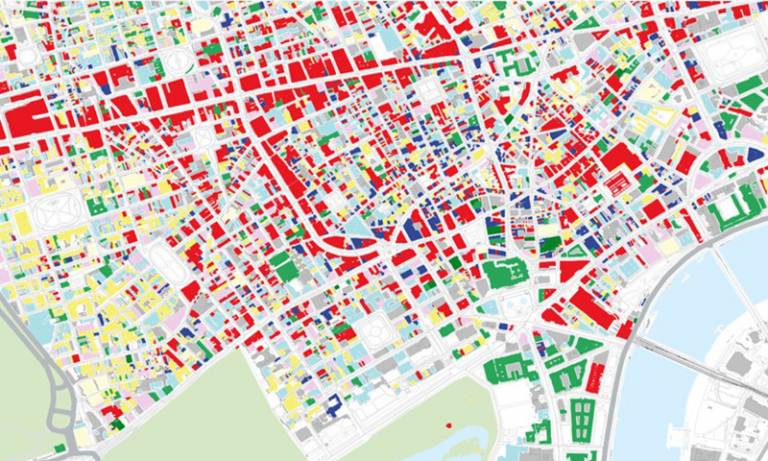
The UCL Space Syntax Laboratory is the international centre of the theory and methodology known as ‘space syntax’. It studies the effects of spatial design on aspects of social, organisational and economic performance of buildings and urban areas.
The Laboratory incorporates the VR Centre for the Built Environment, whose role is to bring the full range of computer graphics, interaction and digital data to the virtual building that currently drives the design-development-operation cycle.
The group is also associated with Space Syntax Limited, a UCL spinout applied research and technology transfer firm, which is currently working on a range of live projects from end-user organisations in industry and local government.
The research undertaken here aims:
- to develop theories and to test these by studying the effects of spatial design on aspects of social, organisational and economic performance of buildings and urban areas
- to integrate computational approaches at the heart of the design process, including structural, societal and environmental analysis
- to develop the generation of design solutions that combine machine learning, optimisation and technological innovation
- to develop and disseminate ways of designing, producing and operating buildings and urban areas using virtual-reality and augmented-reality techniques
- to develop ways of designing for embodied interaction with and through media architecture
In the field
Built on mathematical algorithms and geospatial computer technology, space syntax provides for analysis of spatial configurations of all kinds and at all scales. It has been extensively applied in the fields of architecture, urban design, planning, transportation and interior design.
Space syntax’s theoretical and methodological innovation intersects with a variety of disciplines, including anthropology, archaeology, computer science, urban and human geography, psychology, sociology, medicine, mathematical modelling and physics.
Programmes
Prospective Master's students may also be interested in The Bartlett's related programme Architectural Computation MSc and MRes.
Academic visits
We welcome applications from visiting PhD students and post-doctoral researchers to study alongside our own students.
Visiting PhD students
Research students from overseas universities can apply to study with our own students for three to six months by including a 1500-2000-word research proposal, outlining how you’ll benefit from your time at the lab.
Affiliate academics (post-doctoral visitors)
Academics from overseas institutions can apply to pursue research in the field of space syntax, either individually or in collaboration with UCL staff, for up to a year. You’ll need to contact a member of staff at the lab to act as your host, and submit an outline research proposal and a plan of work.
Key Contacts
Professor Laura Vaughan
Professor of Urban Form and Society
Director of the Space Syntax Laboratory
Send Laura an email
Ava Fatah gen Schieck
Reader in Media Architecture and Urban Digital Interaction
Programme Director, Architectural Space & Computation MPhil/PhD
Send Ava an email
Dr Kayvan Karimi
Senior Lecturer
Director of Space Syntax: Architecture & Cities MSc/MRes
Send Kayvan an email
Manuel Jiménez García
Lecturer in Architecture
Director of Architectural Computation MSc/MRes
Send Manuel an email