 Close
Close


The Bartlett School of Planning offers three internationally renowned master's courses with a shared core curriculum in planning.
About our bachelor's degrees
Our bachelor's degrees at The Bartlett School of Planning place a particular emphasis on:
- Understanding urban change
- Pro-active engagement in urban problems
- Urban design and/or real estate, management and planning
- Urban sustainability, exploring issues in social, economic and environmental fields.
Choose your degree
We offer three bachelor's degrees. All three of the degrees have a shared core curriculum giving you a foundational knowledge of understanding, managing and delivering urban change. Each individual degree also has a series of complimentary modules allowing you to specialise depending on your area of interest and career aspirations.
Urban Studies BSc

Urban Planning and Real Estate BSc

Urban Planning, Design and Management BSc
We strongly recommend that you apply for a maximum of two courses at The Bartlett School of Planning. Multiple applications are less likely to result in an offer of admission. We strongly advise early application, as competition is high.
Register your interest to study a bachelor's degree at The Bartlett School of Planning
Accreditation
The Urban Planning, Design and Management BSc and Urban Planning and Real Estate BSc both offer accredited pathways.
- Royal Institution of Chartered Surveyors (RICS) Accreditation
Both Urban Planning, Design and Management BSc and Urban Planning and Real Estate BSc are fully accredited by the Royal Institution of Chartered Surveyors (RICS) for the Planning and Development pathway.
- Royal Town Planning Institute (RTPI) Accreditation
Both Urban Planning, Design and Management BSc and Urban Planning and Real Estate BSc also have the option to follow a professional degree accredited by the Royal Town Planning Institute (RTPI) if taken as part of the 3+1 professional route. Following the undergraduage degree, you would conclude with a 9-month Postgraduate Diploma or a 12-month MSc programme.
Students on one of these two accredited courses who complete this 4-year route are eligible for RTPI membership, typically after 2 years of work experience.
We offer a number of accredited MSc programmes that are eligible for this 3+1 accreditation route, including:
Structure
Across the three years of your degree you will take a number of individual courses (modules), normally valued at 15 credits, adding up to a total of 120 credits for the year. Modules are assessed in the academic year in which they are taken. The balance of compulsory and optional modules varies from programme to programme and year to year. A 15 credit module is considered equivalent to 7.5 credits in the European Credit Transfer System (ECTS).
The structure of the three years is as follows:
- Year One
Compulsory year one modules for all undergraduates:
- Introducing Planning Systems
- Planning History and Thought
- Urban Lab I: Graphic Skills
- Making Cities: Production of the Built Environment
- Contemporary Cities
- Introducing Urban Design: Design Skills
- Management for Built Environment Professionals I
Compulsory year one specialism for Urban Planning, Design and Management and Urban Studies students:
- Beyond Cities: Rural Economies, Communities and Landscapes
Compulsory year one specialism for Urban Planning and Real Estate students:
- Introduction to Real Estate
- Year Two
Compulsory year two modules for Urban Planning and Real Estate and Urban Planning, Design and Management students. Urban Studies students can exchange modules marked with an * for an elective of their choice (unmarked modules are therefore compulsory). Urban Studies students can take up to 45 credits of electives in year two.
- Urban Lab II: Spatial Analysis
- Urban Design: Theory to Practice *
- Cities and Social Change
- Economics of Cities and their Regions
- Green Futures
- Strategic Planning Project
- Management for Built Environment Professionals II *
Compulsory year two specialism for Urban Planning, Design and Management students:
- Urban Form and Formation
Compulsory year two specialism for Urban Planning and Real Estate students:
- Real Estate Economics
- Year Three
Compulsory year three modules for Urban Planning and Real Estate and Urban Planning, Design and Management students. Urban Studies students can exchange modules marked with an * for an elective of their choice (unmarked modules are therefore compulsory). Urban Studies students can take up to 60 credits of electives in year three.
- Urban Project Management *
- Regional Development, Planning and Policy in a Global Context
- Real Estate Development
- Urban and Environmental Politics
- Planning and Property Law *
Compulsory year three specialisms for Urban Planning, Design and Management students:
- Development Project: Regeneration
- Urban Design: Space and Place
- Transport Policy and Planning (this module is also compulsory for Urban Studies students)
Compulsory year three specialisms for Urban Planning and Real Estate students:
- Real Estate Valuation
- Real Estate Investment and Finance
- Real Estate Management
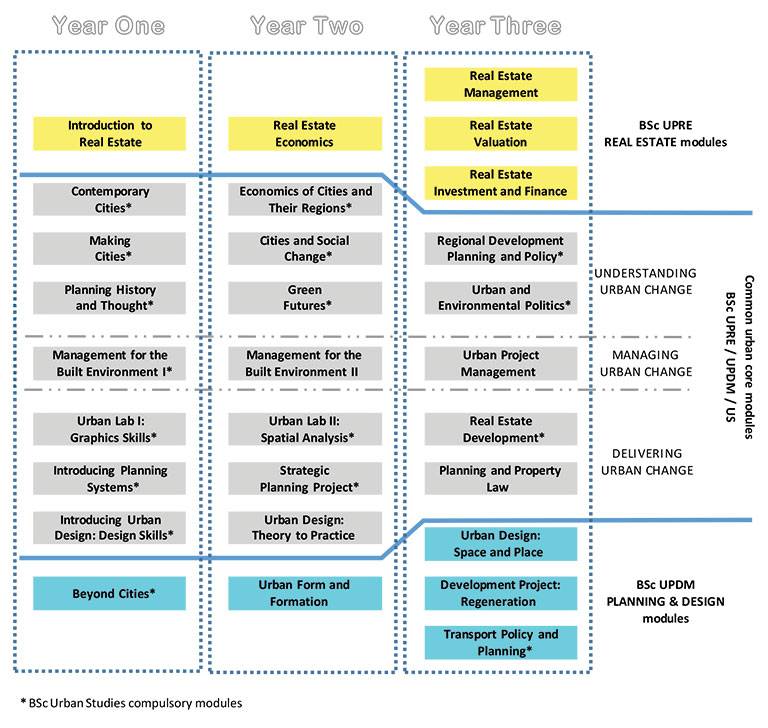
The following diagram visually describes the shape of the three years described above:
 Urban core modules
Each of the BSc programmes offered by The Bartlett School of Planning share a common urban core, giving you an essential foundational knowledge of understanding, managing and delivering urban change, and which develop over the three years of study.
- Understanding Urban Change
This module stream begins by placing settlements in their historical context, and examining why urban areas have developed in the way they have - in spatial and non-spatial ways, and at different scales of development. Early studies also focus on how contemporary cities are continuing to change. The fundamentals of environmental sustainability, economics, sociology, politics and development processes are then examined in depth in years two and three.
- Managing Urban Change
This stream focuses on public and private processes of managing urban change, and the organisations that contribute to it, emphasising the importance of management theory and practice in contemporary professional life. A series of courses present basic management principles, and introduce the fundamentals of planning systems and explore the relationships of the different professionals working in the built environment.
In the second and third years of this work stream, students attend courses on organisational change and urban project management, with further exploration of these themes within the different programme specialisms.
- Delivering Urban Change
This stream emphasises the importance of hands-on project work to give students an opportunity to put into practice the knowledge gained in the other streams through design, regeneration, development and local or strategic planning work.
In addition to these shared modules, you will take specialist modules for your chosen degree throughout the three years of your degree, outlined in the year structure above.
Why choose The Bartlett?
We offer:
- An academic and vocational education in urbanism and the built environment
- An education in planning designed and delivered by current world-leading experts and practitioners
- Close links with policy-makers and professionals in industry
- A central London location with a wealth of urban issues and projects to draw from
- Distinctive programmes including lectures, project-based workshops, site visits and field trips
- An international outlook and student exchange opportunities with North American, European, Asian and Australian universities leading in the field of planning.
Careers and Employability
Recent records indicate that a third of those completing the 3+1 route take up employment in UK local planning authorities. A further third of graduates enter consultancy work, while the remainder take up employment in a wide range of retail, utility, transport and development companies or in non-profit agencies. A minority continue in higher degree studies and research.
Some students take a year out to gain experience in professional practice between their BSc graduation and MSc/Diploma year. Others gain valuable professional practice experience during their summer breaks, for which study in London provides unrivalled opportunities.
Careers
Our programmes enable you to acquire highly transferable knowledge and skills such as data collection and analysis; resolution of problems and conflicts; negotiation and mediation; presenting complex data and ideas; managing work tasks; preparing and writing professional reports; and preparing and using graphics for effective presentations.
Our graduates are equipped to take up employment in a vast range of positions - both within planning and property, and in other sectors where their analytical, negotiating and problem-solving skills are valued. Demand for people with planning skills and the real estate sector in the UK and abroad is strong. A rapidly growing field of work is 'urban regeneration', where people from many professions, sectors and organisations collaborate on urban and regional projects.
Graduates work in a variety of fields specialising in economic development, regeneration, social development, housing, travel, public space improvements and community participation. Due to the nature of two of our BSc programmes as a route for eligible membership of RTPI, many of our graduates also go on to further study.
Destinations
First career destinations of recent graduates (2012-2014*) of our programmes include:
- Graduate Chartered Surveyor, Savills
- Graduate Surveyor, DTZ
- Graduate Town Planner, Peter Brett Associates
- Graduate Planner, Southwark Council
- Graduate Engineer, WSP Group
- Graduate Surveyor, Bennett Homes
- Real Estate property Valuer, Adventis Real Estate management (Serbia)
*Data taken from the 'Destinations of Leavers from Higher Education' survey undertaken by HESA. Please note that the first Planning and Real Estate cohort graduated in 2015 so this data is mostly based on our other programmes.
UCL is committed to helping you get the best start after graduation. Read more about how UCL Careers support services are helping our students boost their employability and find jobs.
Work Shadow Programme
Students have the opportunity to undertake a work shadow placement with a major planning employer in term 3 of their third year.
The work shadow programme aims to give students a chance to experience what it is like to work in a sector of the industry that employs people with planning degrees. Students participating in the programme undertake a two-week placement with one of a number of key employers - including both private companies and London boroughs - from across the planning sector.
The two-week work shadow experience is book-ended by two half-day workshops at UCL jointly run by the school's Careers Coordinator and a consultant from the UCL Careers Service. The first workshop covers: transferable skills to the workplace from students' previous experiences; professional and workplace etiquette; and goal setting. The second workshop shares the diverse work shadow experiences from the student cohort, opportunities that arose, and reflections on the next steps of career development.
Employers participating in the 2019 Bartlett School of Planning work shadow programme:
- AECOM
- Arup
- Barton Willmore
- Farrells
- Gerald Eve
- GL Hearn
- JLL
- Levitt Bernstein
- Nexus Planning
- Peter Brett Associates
- RPS CgMs
- The London Borough of Camden
- The London Borough of Ealing
- The London Borough of Southwark
- Tibbalds Planning and Urban Design
- Transport for London
- WYG
Staff
- Programme Director (Urban Planning, Design and Management & Urban Studies)
Elena Besussi
View Elena's profile- Programme Director (Urban Planning and Real Estate)
Danielle Sanderson
View Danielle's profile- Programme Administrator
Miss Eliza Fleming